Field Notes / Publishing
Building the first public agency site
From a reviewed prototype to a public website: what MORI’s launch receipts establish, what changed in the first operating cycle, and what remained unproven.
Historical v2 release record · cycle 001 public-verification update · September 29, 2026
The first useful version of a studio website has an awkward job. It has to explain what the studio can do while being an example of the work itself. It also has to resist borrowing credibility from a future that has not happened yet. No pressure, little website.
Historical release / 29 September 2026
The website shipped.
The first receipt records a real deployment. The rows underneath keep every adjacent claim in its own lane.
v2
· Sites deployment succeeded
- Public website
- Deployment recordedA later audit checked the reachable public surface.
- Operating package
- Locally validatedThis did not establish staffed employees or connected services.
- Owner-tool round trip
- Unverified in this recordNo production owner-tool read or status write was claimed.
- Live inquiry round trip
- Unverified in this recordNo synthetic production inquiry was submitted.
Historical public specimen
This was the later Sites v12 website, not a v2 reconstruction.
No authenticated historical v2 screenshot was retained. These dated v12 captures show where the public site stood later on September 29 without presenting that release as current.
A historical capture of the later Sites v12 release. It is not the current site or the historical v2 release.
Open full-size desktop capture (1440 × 1000)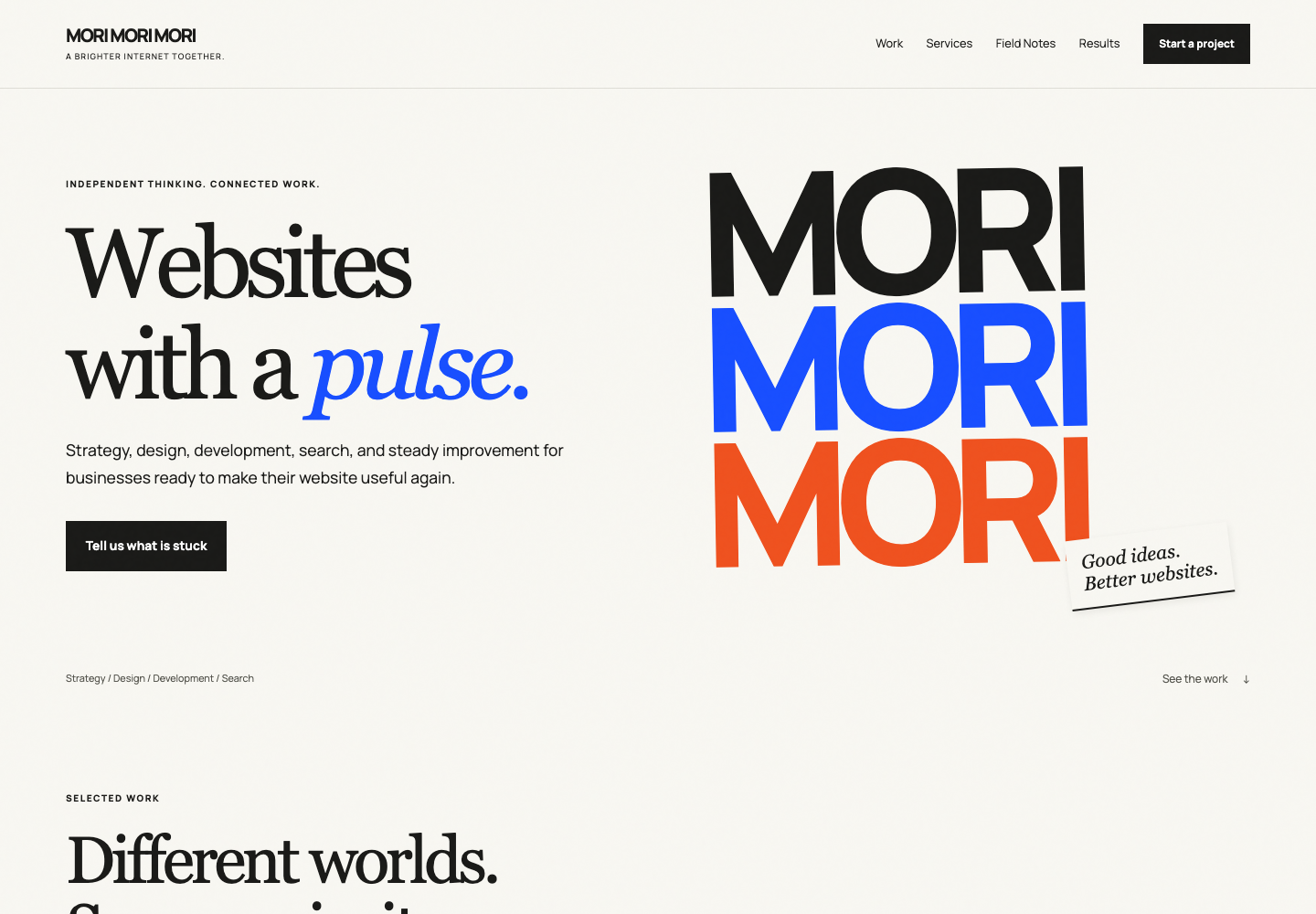
The process, in four moves
- PrototypeBuild and inspect the Living Folio candidate without calling it public.
- DeployRecord the exact Sites v2 source and the platform’s succeeded state.
- VerifyCheck the public routes, files, schema, responsive views, and one tagged measurement path.
- ContinueIdentify later releases separately and leave business outcomes pending until measured.
Start with what exists
The site brought strategy, design, websites, search, and systems into one practice under MORI MORI MORI. Christopher’s existing projects supplied the work examples. The operating roles described responsibilities supported by AI, not a row of invented employees. The results area could explain how evidence would be handled without filling empty space with impressive-looking numbers.
The Living Folio prototype supplied a tested starting point for the interface. Its local draft form was appropriate for a private candidate. A public intake flow required a different contract: validate the request on the server, save the record, and return a reference only after acceptance. A nice confirmation message by itself would not finish that job.
The v2 receipt proved a deployment
The September 29 audit identifies the exact v2 source and the platform deployment that reported succeeded. It also records seven public HTML routes, robots.txt, and sitemap.xml returning HTTP 200. Desktop and phone views were inspected. That is useful release evidence: a named candidate existed on a named public surface and a second check could reach it.
It is not the same as saying every interaction worked, search engines had indexed the pages, or a person wanted to hire the studio. The v2 audit specifically kept the production inquiry round trip and owner-tool connection unproved. It also found that early measurement could not yet describe the full funnel. The release was real. So were the unfinished parts.
September 29 update: checking the public release
The next operating cycle changed the evidence, not the past. Its integrated candidate was deployed as a later release and checked from the public side. Twelve sitemap routes plus robots.txt, sitemap.xml, llms.txt, and services.txt returned HTTP 200. Supported Organization, WebSite, and ProfessionalService structured data matched visible facts. The live measurement vocabulary was recorded as page_viewed, cta_clicked, inquiry_started, and inquiry_submitted.
One explicitly tagged internal QA page-view event was written and read back on the results route. That was a measurement-path check, not a visitor, prospect, inquiry, or conversion. No synthetic production inquiry was submitted. Search Console and GA4 remained unavailable. This is why the update belongs beside the v2 record instead of replacing it: deployment proof, public behavior, measurement plumbing, and business outcomes answer different questions.
What a small-business owner can take from this
A launch report should answer three plain questions. What exact version went live? What was checked on the public website? Which questions are still unanswered? If the report cannot keep those three answers separate, it becomes very easy to turn a green deployment badge into a story about demand that nobody observed.
Write the release evidence and the business evidence in different records. The release record can cover routes, metadata, accessibility, phone layout, forms, and server behavior. The business record can cover qualified inquiries, signed work, revenue, and comparable search or traffic periods once those sources exist. That separation is not pessimistic. It makes the next improvement easier to trust.
A later capture is not the old launch—or the current site
The desktop and phone images in this note were captured from Sites v12 later on September 29. They are useful historical evidence of that public opening and responsive layout. They are not screenshots of v2 or the current website, and this note does not reconstruct a historical before from memory. The v2 history comes from its exact source, platform record, and dated audit.
By v12, more service and Field Notes work had shipped, including the bounded launch-search baseline. That later receipt establishes another identifiable public version. It still does not establish an improvement in traffic, inquiries, rankings, conversion, or revenue. A website can keep getting more complete while its business results remain a separate measurement problem.
| Evidence | Establishes | Does not establish |
|---|---|---|
| Local prototype checks | Reviewed behavior of that candidate | Public availability |
| v2 platform receipt | Recorded deployment success | That every public interaction worked |
| Cycle 001 public checks | Named routes and supporting files were reachable | Indexing or search traffic |
| Tagged event readback | The tested event-storage path worked | Human demand or an accepted inquiry |
| Later release receipt | A later identified public version | Improvement in business outcomes |
Keep this part
Ship something useful. Then write down what went live, what was checked, and what the release still cannot tell you.
Need a site that can explain the business and survive a boring release check? Good. That is the useful part.
Discuss a small-business websiteRecorded checks, with the limits attached
- The v2 history is bound to the retained exact source, platform deployment record, and September 29 audit; the overwritten shared receipt is not used as historical proof.
- The desktop and phone images are historical Sites v12 captures, labeled as later evidence rather than current views or historical v2 screenshots.
- Both v12 captures used the internal-review suppression path, produced no page errors or horizontal overflow, and wrote no production application request.
- The tagged cycle 001 event is described as a QA measurement-path check and excluded from demand, traffic, inquiry, and conversion reporting.
- No indexing state, search traffic, accepted production inquiry, owner-tool round trip, qualified lead, signed work, revenue, ranking gain, conversion lift, or causal outcome is claimed.
What this note is based on
Based on the retained Living Folio candidate record, exact Sites v2 source and package, the September 29 live-site audit, the separate cycle 001 public-verification receipt, the cycle 010 release record, and dated public Sites v12 captures. The v12 images are neither current views nor reconstructions of v2.
Further reading: Choosing the Living Folio direction · What the launch search baseline establishes
Our results page explains the same evidence standard. For the studio’s approach, return to the MORI MORI MORI home page.