Field Notes / Prototype
Choosing the Living Folio direction
A tactile, readable home for the work—and the difference between liking a picture and living with a page.
Local prototype built and checked · distinct from the later public site
A concept image can be very persuasive. It does not have to fit a phone, take keyboard focus, or tell someone what happened after they pressed a button. The Living Folio direction got more interesting when it had to do those things.
From picture to page
One idea. Three useful views.
The concept set the tone. The local prototype gave it something to do.
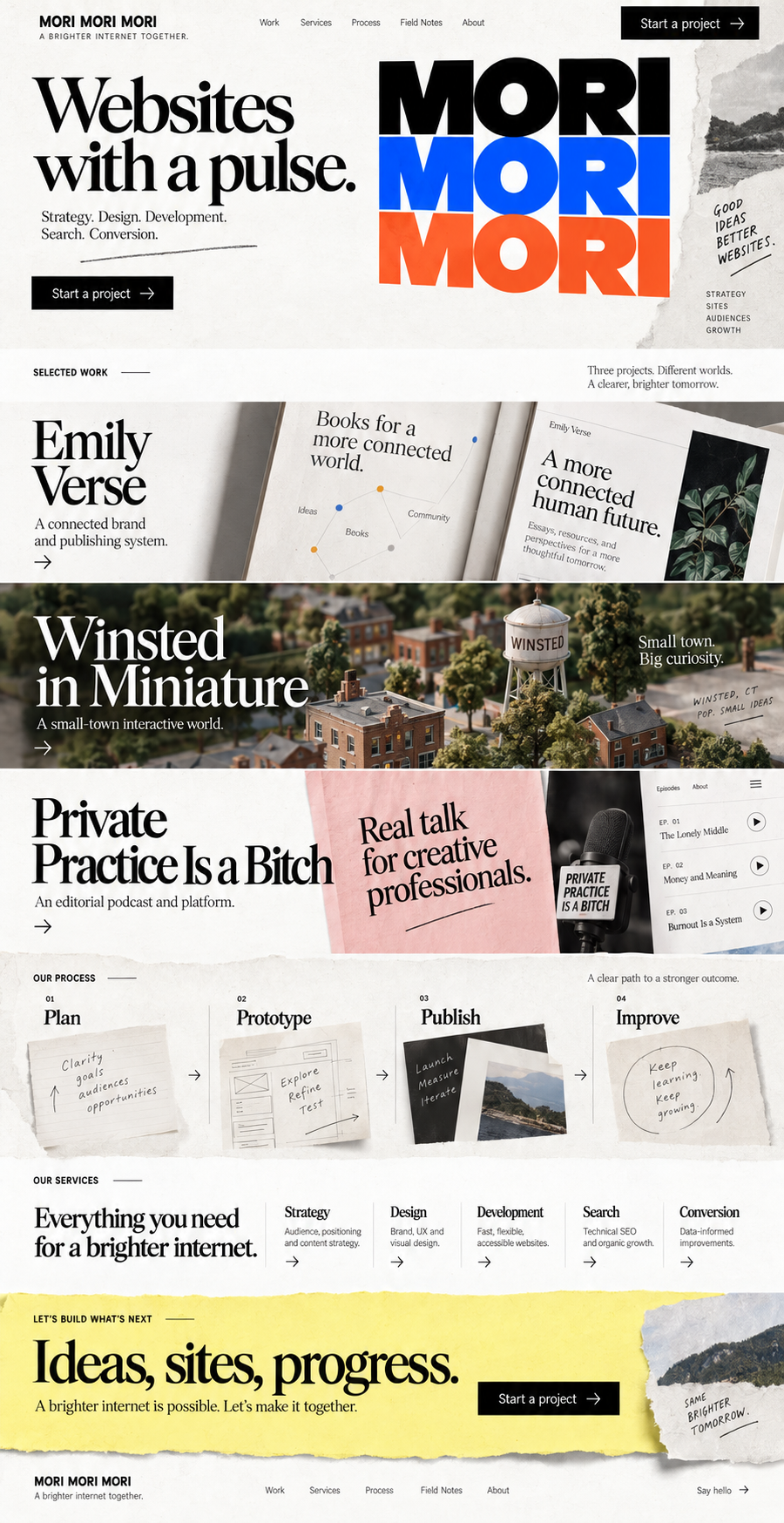
The composition that started the build. A visual direction to translate, with interface decisions still to make.
Open full-size concept (900 × 1748)Scroll within the image to follow the whole composition.
The process, in four moves
- StudyCompare the first three composition directions.
- RefineReduce competing emphasis and clarify the reading order.
- PrototypeBuild Living Folio with real content and local draft behavior.
- CheckInspect desktop, phone, keyboard, and reduced-motion behavior.
Choose a rhythm, not a screenshot
The earlier concept study explored Kinetic Editorial, Living Workshop, and Digital Showroom. Those were composition studies, not finished products. The later Living Folio concept carried forward a more specific idea: tactile paper, one expressive opening, real work, a clear reading sequence, and purposeful motion. The local prototype translated that concept; it did not ship it.
That distinction mattered. Reproducing every pixel of a concept would have preserved decisions the image never had to defend. Building the direction meant keeping its rhythm while solving the actual interface: navigation, services, project details, notes, and an inquiry draft.
Let real work set the scale
Existing in-house project previews gave the page something real to organize around. They were portfolio assets, not fresh proof that every public project still looked exactly the same. The candidate documented that limit. A picture can show the work without quietly becoming a claim about a current release.
The typography and paper treatment gave those previews a common setting. The goal was a folio that felt handled and considered, with enough structure to make the information easy to find. If the visual treatment made the work harder to read, the treatment was losing the argument.
A prototype should answer uncomfortable questions
The local build included responsive navigation, project dialogs, service disclosures, and keyboard focus behavior. The inquiry interaction saved a local draft, restored it, downloaded it, or deleted it. It did not send anything. The button and confirmation said so. That let the flow be reviewed without pretending an intake service already existed.
The verification record covered desktop and phone layouts, reduced motion, focus restoration, and a narrower viewport used to examine enlarged-layout behavior. Actual browser-toolbar zoom was not exercised in that prototype check. That qualification tells the next review what still needs attention.
Choosing Living Folio was choosing a system we could keep testing. The image began the conversation. The working page supplied the useful objections.
| Question | Concept study | Working prototype |
|---|---|---|
| Does it feel right? | Composition and tone | Tone across a full reading sequence |
| Can I use it? | Implied interactions | Navigation, dialogs, validation, focus |
| Did an inquiry arrive? | Cannot establish this | No: local draft behavior only |
| Is it public? | No | Not until a separate release |
Keep this part
Choose the direction for the decisions it helps you make after the picture stops being the deliverable.
Recorded checks, with the limits attached
- Historical local captures: desktop at 1440 CSS pixels and phone at 390 CSS pixels, September 29, 2026.
- The prototype verification record covered navigation, dialogs, service disclosures, keyboard focus restoration, and reduced motion.
- Local draft validation, save, restore, download, and deletion were checked; no external inquiry delivery was claimed.
- The enlarged-layout check used a 720 CSS-pixel viewport, equivalent in width to 200% zoom in a 1440px window. Actual browser-toolbar zoom was not exercised.
- These checks document the local candidate. They establish no public release, visitor response, conversion lift, or business outcome.
What this note is based on
Based on the concept review README, brand-system design brief, and Living Folio candidate README. The prototype’s recorded checks are historical local evidence.
Our results page explains the same evidence standard. For the studio’s approach, return to the MORI MORI MORI home page.